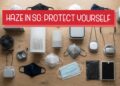









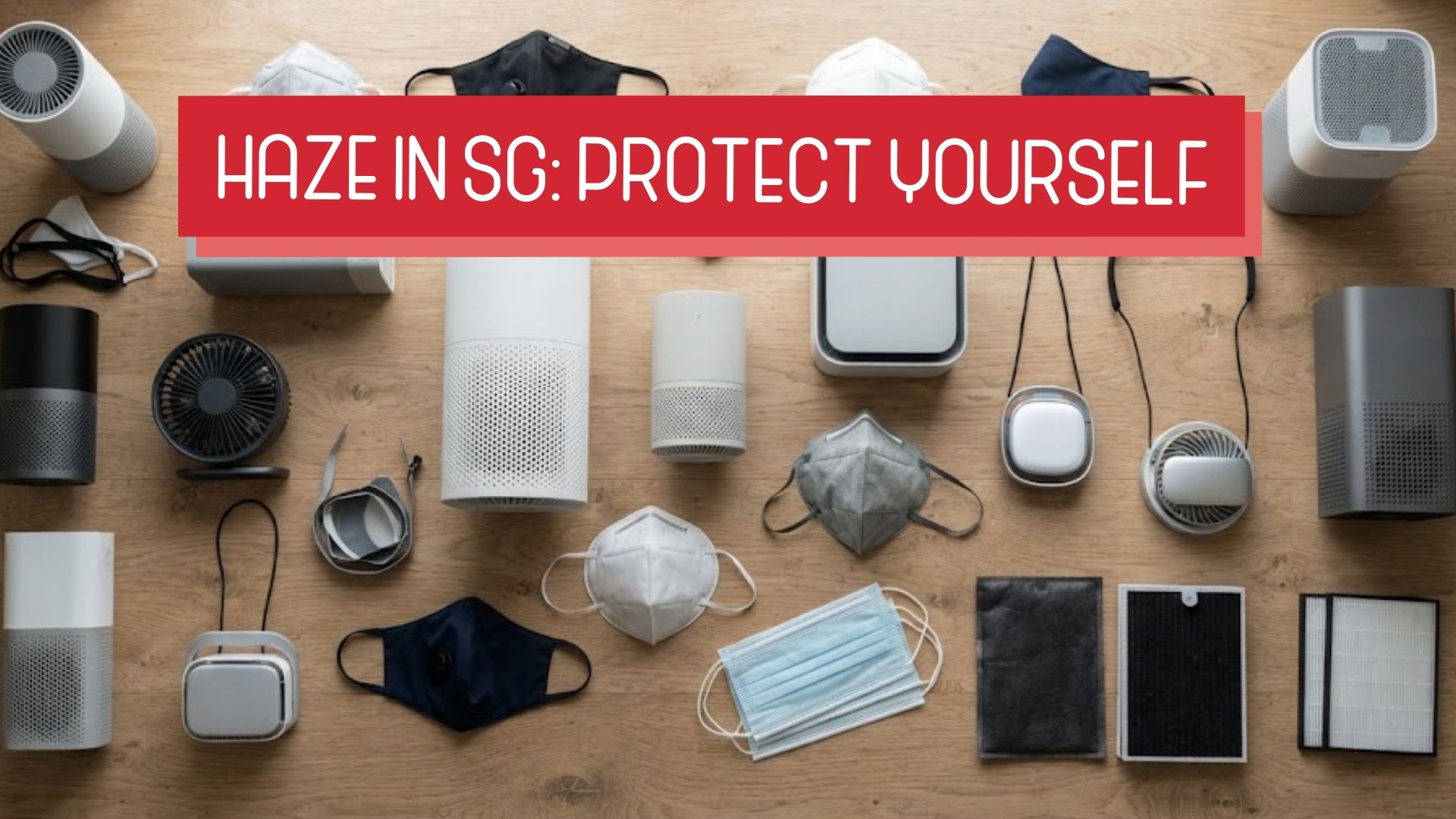
When haze hits Singapore, the first instinct may be to buy an N95 mask, an air purifier, or anything that promises “PM2.5 protection”. But not every product is equally useful, and not everyone needs the same level of protection.
Singapore experienced an Unhealthy 24-hour PSI reading of 101 on 4 September 2026, the first time the 24-hour PSI entered the Unhealthy range due to haze since October 2023. NEA reported that smoke plumes from fires in Sumatra and Kalimantan were drifting towards Singapore, with continued dry conditions potentially allowing transboundary haze to persist.
So, what should you actually buy for haze in Singapore?
The short answer is: an appropriately fitted N95 mask for prolonged outdoor exposure when advised, and a suitable air purifier if indoor particulate levels are a concern. But the most important protection is often not a product at all — it is reducing prolonged outdoor exposure and strenuous activity when air quality deteriorates.
What Is Haze and Why Is It a Concern in Singapore?
Haze is polluted air containing a mixture of gases and fine particles, often associated with smoke from regional vegetation and forest fires.
For Singapore, the main pollutant of concern during smoke haze is PM2.5, referring to fine particulate matter measuring 2.5 microns or smaller. These tiny particles can enter buildings through fresh-air intakes, openings and gaps.
Haze can cause temporary irritation such as:
- Irritated eyes
- Scratchy or irritated throat
- Nose irritation
- Coughing
- Breathing discomfort
- Headaches or general discomfort
The impact depends on several factors, including the PSI level, length of exposure, physical exertion and individual health status.
This means there is no single answer to “what should I buy for haze in Singapore?” The right approach depends on whether protection is needed outdoors, indoors, for commuting, for working outside, or for vulnerable household members.
What Should You Buy for Haze in Singapore?
If preparing a basic haze protection kit in Singapore, focus on products that address the two main situations:
For outdoor protection
Buy:
- Properly fitted N95 masks
- Enough masks for household members who may need them
- Appropriate sizes for the intended users (eg. children)
For indoor protection
Consider:
- A portable air purifier
- A purifier with an appropriate CADR
- Replacement filters
- A device suitable for the room size
Also useful
- A way to check Singapore’s PSI and PM2.5 readings
- Plenty of drinking water
- Regularly maintained air-conditioning or ventilation systems where applicable
Buying products alone is not enough. Reducing exposure remains one of the most important ways to manage haze.
1. N95 Masks: What to Buy for Haze Outdoors
The N95 mask is probably the first product people think about when asking, “What mask should I buy for haze in Singapore?”
N95 masks are designed to filter fine particles, including PM2.5. However, their effectiveness depends heavily on achieving a good seal around the face. If there are significant gaps, polluted air can bypass the filter.
Does an N95 mask protect against PM2.5?
Yes. According to Singapore’s Ministry of Health and NEA, properly fitted N95 masks provide good protection against fine particle pollutants such as PM2.5.
But an N95 mask is not automatically necessary every time there is haze.
For example, current Singapore guidance states that N95 masks are generally not needed for short exposure such as commuting to school or work, nor are they generally required indoors.
For healthy people, N95 use becomes particularly relevant when prolonged outdoor exposure is unavoidable during Hazardous air quality, above PSI 300.
How Do You Know When to Wear an N95 Mask During Haze?
This is one of the most common Singapore haze questions.
The answer depends on both air quality and exposure duration.
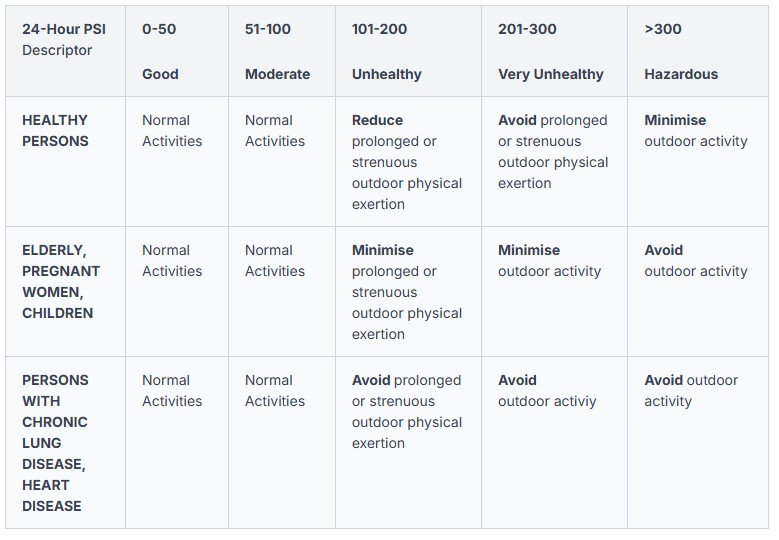
According to current MOH guidance:
| 24-hour PSI | General situation |
|---|---|
| 0–50 | Good |
| 51–100 | Moderate |
| 101–200 | Unhealthy |
| 201–300 | Very Unhealthy |
| >300 | Hazardous |
At Unhealthy levels, healthy people should reduce prolonged or strenuous outdoor physical activity. At Very Unhealthy levels, outdoor activity should be reduced further, particularly for vulnerable groups.
 Important distinction
An N95 mask should not be treated as permission to continue prolonged outdoor activity during severe haze.
If the air quality is very poor, the better strategy is still to avoid or minimise outdoor exposure whenever possible.
2. What Air Purifier Should You Buy for Haze in Singapore?
An air purifier for haze can be useful when the objective is to reduce airborne particulate matter indoors.
However, simply buying the biggest-looking or most expensive air purifier is not necessarily the best approach.
The important specification to understand is CADR — Clean Air Delivery Rate.
NEA explains that CADR indicates the amount of clean air an air cleaner can produce. A higher CADR generally indicates a greater ability to return clean air to a room, making the room size and purifier’s CADR important considerations when choosing a device.
What to check before buying an air purifier for haze
Look at:
- CADR
- Recommended room size
- Particle filtration capability
- Replacement filter availability
- Replacement filter cost
- Noise level
- Energy consumption
- Whether the manufacturer provides supporting performance information
Why CADR matters more than simply buying “a purifier”
Imagine buying an air purifier designed for a small bedroom and placing it in a large living room.
It may still clean some air, but it may not move and filter enough air to provide the desired particulate reduction efficiently.
Therefore, the better question is:
“What CADR do I need for my room?”
rather than:
“Which air purifier is the most powerful?”
Do You Need an Air Purifier If You Already Have Air-Conditioning?
Not necessarily — but air-conditioning does not automatically mean that indoor air is completely protected from haze.
NEA notes that PM2.5 can enter air-conditioned buildings through fresh-air intakes, as well as openings and gaps.
This makes indoor haze management more nuanced than simply saying:
Air-con = no haze.
For households concerned about indoor particulate levels, an appropriate portable air cleaner can provide an additional layer of particle filtration.
The practical priority is to:
- Keep windows and doors closed when outdoor air quality is poor
- Reduce unnecessary outdoor-air infiltration where practical
- Use appropriate air-conditioning settings
- Consider a suitable air purifier
- Replace filters according to manufacturer guidance
Should You Buy a HEPA Air Purifier for Haze?
A common search is:
“Is HEPA air purifier good for haze?”
For haze-related particle pollution, the important objective is effective removal of fine airborne particles.
Rather than choosing a purifier solely because the packaging says “HEPA”, check the manufacturer’s particle-removal information and the device’s CADR.
NEA specifically advises consumers to obtain manufacturer information supporting claims about fine-particle removal, particularly for air purifiers without a CADR rating.
In other words:
HEPA is useful information, but it should not be the only purchasing criterion.
What Should Families Buy for Haze in Singapore?
Families should avoid automatically assuming that everyone should wear an N95 mask.
Children are a particularly important consideration because obtaining a proper seal can be difficult, and N95 certification standards such as NIOSH are designed for adults in occupational settings rather than children.
For children, the more fundamental haze protection strategy is usually:
- Reduce prolonged outdoor activity
- Avoid strenuous outdoor exercise when advised
- Monitor air quality
- Keep indoor environments comfortable
- Follow medical advice where relevant
Parents should not simply purchase an adult N95 and assume it provides effective protection for a child.
What About Elderly People and Pregnant Women?
Haze protection should be more cautious for vulnerable groups.
Singapore’s health advisory specifically identifies elderly people, pregnant women, children and people with chronic heart or lung conditions as groups requiring additional consideration during periods of deteriorating air quality.
For vulnerable individuals, the priority is generally to minimise outdoor exposure, particularly when air quality reaches Very Unhealthy levels.
People with severe heart or lung conditions who are considering N95 use should consult their doctor, particularly if they experience difficulty breathing.
What Should Outdoor Workers Buy During Haze?
Outdoor workers have a different exposure profile from someone walking from an MRT station to an office.
Outdoor work can involve:
- Several hours of exposure
- Physical exertion
- Heat
- Increased breathing rate
- Repeated daily exposure
This is why workplace haze precautions may apply at lower air-quality thresholds than advice for the general public.
NEA advises employers to consider measures such as reducing prolonged outdoor work, providing suitable masks where necessary, implementing breaks and considering the nature of the work when assessing risk.
For outdoor workers, purchasing decisions should therefore be based on workplace risk assessment and applicable workplace guidance, rather than simply buying whatever mask is available.
What Is the Best Haze Protection Kit for a Singapore Home?
A practical Singapore haze protection kit does not need to be complicated.
Basic kit
1. N95 masks
For situations where prolonged outdoor exposure cannot be avoided and mask use is advised.
2. Air purifier
Useful for reducing indoor airborne particles, particularly in enclosed rooms.
3. Replacement filters
An overlooked item. An air purifier is only useful if its filtration system is properly maintained.
4. Drinking water
MOH advises staying well hydrated during haze periods.
5. Air-quality information source
Use official Singapore air-quality updates rather than judging haze severity solely by how clear the sky looks.
What Should You NOT Buy for Haze?
This is an important blue-ocean question because consumers often focus on what to purchase rather than what not to purchase.
1. Don’t stockpile excessive N95 masks
Singapore’s health guidance does not recommend buying N95 masks unnecessarily or treating them as an everyday requirement during ordinary air quality.
2. Don’t buy an air purifier based only on its appearance
A large purifier is not necessarily suitable for a large room. Check CADR and room suitability.
3. Don’t assume any face mask equals an N95
A loose-fitting general-purpose mask does not provide the same particle-filtering and face-sealing characteristics as a properly fitted N95.
4. Don’t rely only on “anti-haze” marketing claims
Look for meaningful technical information about particle filtration and performance.
5. Don’t assume an N95 makes strenuous exercise safe
A mask can reduce particle exposure, but it does not eliminate the need to follow outdoor-activity advisories.
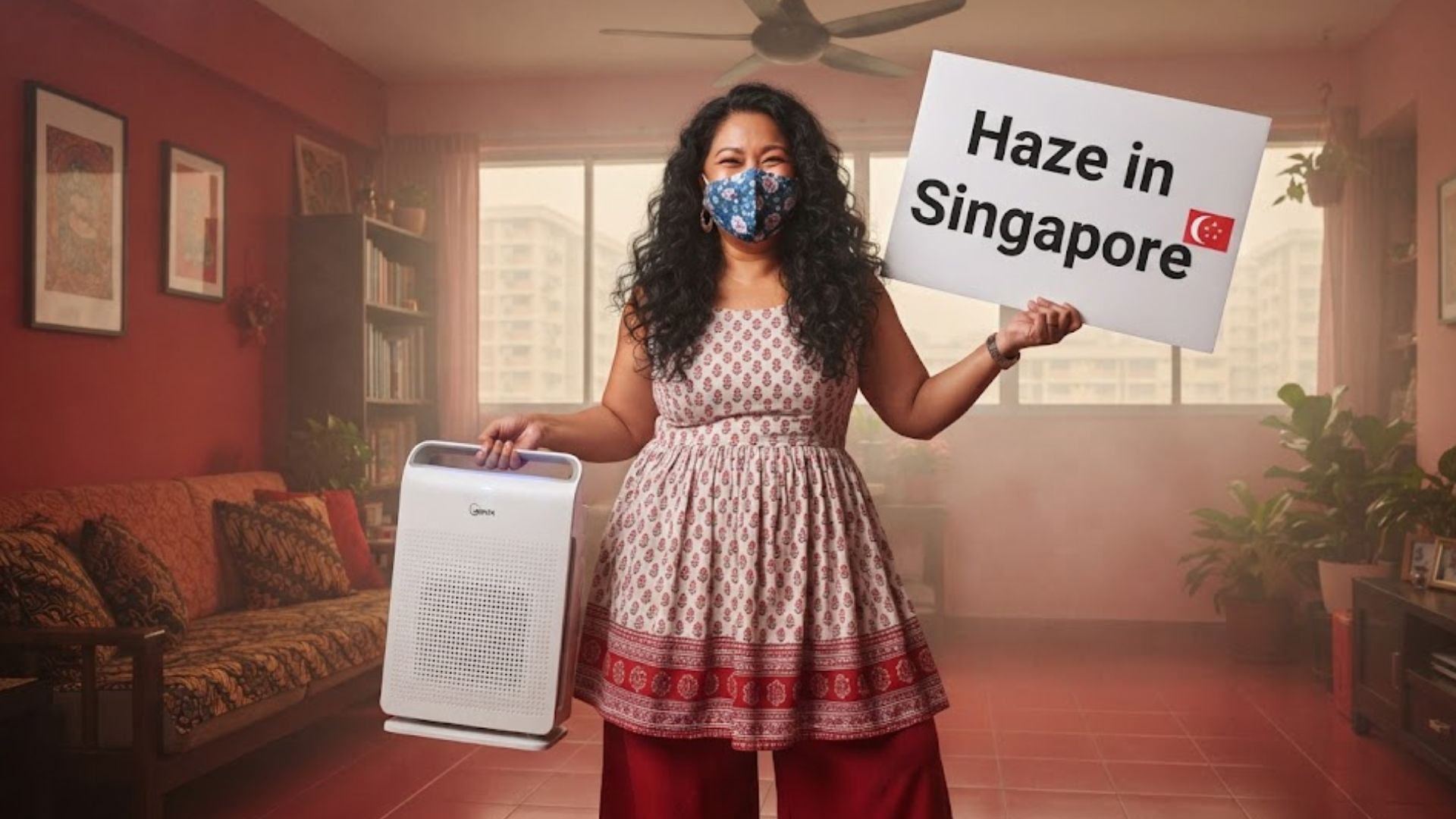
How to Protect Yourself From Haze Without Buying Anything
The most underrated haze protection strategy is behavioural rather than commercial.
When air quality worsens:
Reduce prolonged outdoor activity
If an activity can be postponed, consider postponing it.
Reduce strenuous exercise outdoors
Running, cycling and intense outdoor workouts increase breathing rates and therefore exposure.
Stay indoors when appropriate
For more severe haze conditions, staying indoors can reduce exposure.
Keep hydrated
MOH specifically advises drinking plenty of water during haze periods.
Monitor official air-quality information
NEA advises using the 1-hour PM2.5 reading for immediate outdoor activities and the 24-hour PSI forecast for planning activities for the following day.
PSI vs PM2.5: Which Should You Check During Singapore Haze?
This is another question that causes confusion.
PSI provides an overall indication of air quality and haze severity.
PM2.5, meanwhile, measures the concentration of fine particulate matter.
For practical decision-making, both can be useful.
According to NEA’s 4 September 2026 haze advisory, the 1-hour PM2.5 reading should be considered when planning immediate outdoor activities, while the 24-hour PSI forecast can help with planning activities for the next day.
So rather than asking:
“Is the PSI bad?”
a better question is:
“What is the current PM2.5 level, what is the forecasted PSI, and how long will the outdoor activity last?”
That gives a much more useful picture of exposure.
Singapore Haze FAQ: Common Questions People Ask
Is haze dangerous in Singapore?
The health impact depends on the severity of the haze, exposure duration, physical activity and individual health status. At lower levels, healthy people may experience little more than irritation, while more severe haze can pose greater concerns, particularly for vulnerable individuals.
What is the best mask for haze?
A properly fitted N95 mask provides good protection against fine particle pollutants such as PM2.5. Fit is critical because gaps around the face can allow polluted air to bypass the filter.
Do I need an N95 mask for daily commuting?
Generally, no, for short exposure such as commuting to work or school. Current Singapore guidance says N95 masks are not generally needed for short exposure or indoors.
Should I wear an N95 mask indoors?
Generally, N95 masks are not required indoors under Singapore’s current haze guidance. Indoor air management, including reducing outdoor-air infiltration and using suitable air cleaning where appropriate, can instead help manage particulate levels.
Does an air purifier remove haze?
A suitable portable air cleaner can help reduce airborne particulate matter indoors. Its effectiveness depends on factors including CADR, room size and filtration performance.
What should I look for when buying an air purifier for haze?
Prioritise CADR, room size suitability, particle-removal performance, filter availability and replacement costs.
Is PM2.5 the same as PSI?
No. PM2.5 is a measurement of fine particulate matter, while PSI is an index used to describe overall air-quality conditions.
Should children wear N95 masks during haze?
N95 masks are not specifically designed or certified for children in the same way they are for adults. Proper fit can also be difficult. Children should generally minimise outdoor activity when air quality deteriorates and parents should follow current official guidance.
What should I buy before haze season in Singapore?
A sensible preparation is to have a small supply of appropriately sized N95 masks for situations where they may be needed, maintain suitable indoor air-conditioning and filtration, and consider an appropriately sized air purifier if indoor particulate management is a concern.
There is generally no need to panic-buy or stockpile large quantities.
Where to Check Singapore Haze Updates
During an active haze episode, rely on official information rather than social-media speculation.
Useful sources include:
- NEA Singapore
- Haze.gov.sg
- Ministry of Health Singapore haze advisory
- myENV app for environmental information and updates
NEA’s latest haze advisory specifically recommends checking the official haze microsite, NEA, Meteorological Service Singapore and myENV for updates.
What to Buy for Haze in Singapore
If the question is simply “What should I buy to protect myself from haze in Singapore?”, keep it practical.
For outdoor exposure:
Buy a properly fitted N95 mask, but use it according to the official health advisory rather than wearing one unnecessarily.
For indoor air:
Consider an air purifier with an appropriate CADR for the room, particularly if reducing indoor particulate levels is a priority.
For children and vulnerable household members:
Prioritise reducing outdoor exposure and follow official or medical advice rather than assuming an adult N95 is suitable.
For everyone:
Check PSI and PM2.5, reduce prolonged or strenuous outdoor activity when advised, stay hydrated and avoid unnecessary exposure.
Ultimately, haze protection in Singapore is not about buying the most expensive mask or air purifier. It is about matching the right protection to the air quality, duration of exposure, activity level and needs of the people in the household. With a few sensible preparations and reliable information from Singapore’s authorities, haze days can be managed without unnecessary panic or overspending.